Systellar’s founders know how spacecraft get engineered.
Two systems engineers knew exactly what tool their industry was missing. Since spring 2025 we’ve been their embedded engineering team, with Wojciech as technical lead, and built synapse™ with them from zero. It’s in production with paying customers, and Systellar is raising again after Techstars London.
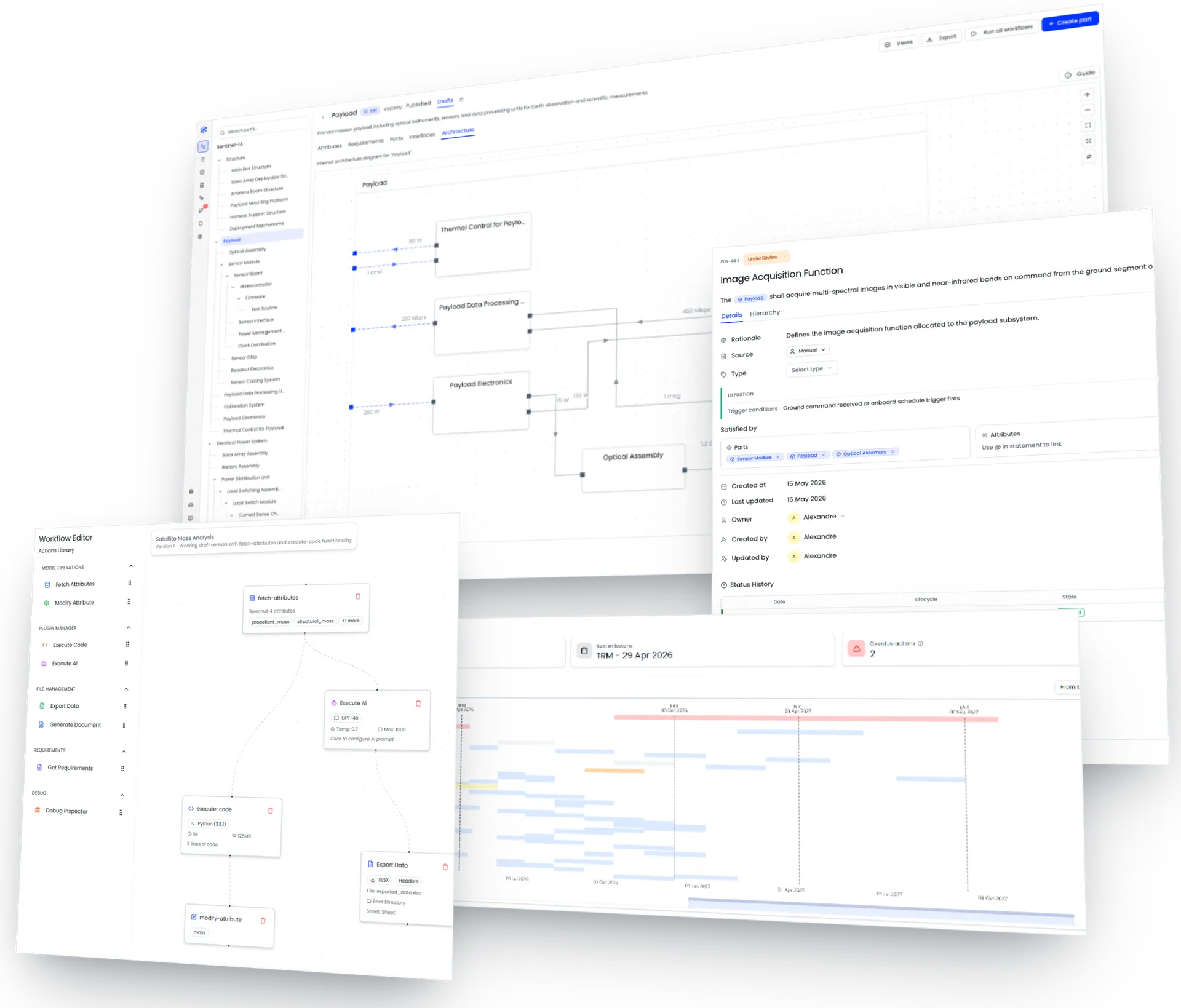
- Embedded team
- Engagement shape
- Spring 2025
- Started, still running
- Wojciech + 2 devs
- Team on it
- Paying customers
- In production
What the founders brought.
Systellar is the kind of client we build for: people with domain depth we will never have.
Sergi Company Co-founder · CEO
- Years implementing model-based systems engineering at Airbus, Rolls-Royce, and GMV
- Inside the heavyweight tooling the industry runs on (Capella, CAMEO)
Alexandre Gol Mestre Co-founder · CTO
- Mission operations at Open Cosmos and Exotrail
- Commissioned a thruster in orbit, ran a launch campaign at Vandenberg
Sergi knows first-hand why those tools fail the teams they’re sold to. Between them the two cover how complex systems get modeled and how they get operated.
Ask Alexandre what’s wrong with the industry’s tooling and he’ll describe an ordinary workday: requirements tracked in Excel, design reviews assembled in PowerPoint, and the system model itself in a modeling suite most of the team can’t drive. The primitive tools stick around because the professional ones ask too much of everyone who isn’t a modeling specialist.
That knowledge is why synapse™ exists: a workspace where teams designing complex hardware keep the system model, requirements, and documentation connected, so every change stays traceable from design to manufacturing. What neither founder had done before was ship and operate a production web product, and at their stage hiring a senior team in-house wasn’t realistic.
How it started.
Alexandre posted an architecture question in a public engineering forum. Wojciech answered it, for free, and after a few messages offered a consultation.
For a month or two after that, the relationship was occasional emails about fundamentals: which stack, which framework, how a modern web app fits together. Then Systellar paid us for the first time, for an exploration: could synapse™ get real SysMLv2 modeling without dragging in the industrial MBSE services the founders already knew too well?
The calls on record.
The call to own the core
The fast path for the modeling core was to lean on an existing heavyweight MBSE service, and technically it would have worked. We came back with a timeline and the honest tradeoffs, and the recommendation ran the other way: own the modeling core in-house, because the product’s whole promise depends on how it feels to use, and you don’t control that through someone else’s dependency. The founders took the recommendation and made the call. Today “SysMLv2 modeling without the complexity of heavyweight MBSE tools” is a line on Systellar’s own homepage.
The call we didn’t make
In mid-2026 the access-control layer needed a rethink. Alexandre had worked through the actual use cases and argued that hierarchy-based access propagation should go entirely. Wojciech endorsed the simplification and wrote up the engine options the way we always do, as a written proposal with tradeoffs: Cerbos, Topaz, Cedar, SpiceDB, each with what it would cost and what it would lock in. Alexandre’s answer settled it.
“We want to let the user decide this, not us.” Alexandre, in the project tracker
He was right, and it simplified the whole design. The decision record sits in the repo as an RFC, written five months before the code. Cerbos replaced the hand-rolled layer in August 2026, in a single reviewed migration touching ~980 files.
The system that keeps evolving
Version control, the ability to change a system model with an audit trail, is one of the most complex systems built into synapse™. It shipped in September 2025 and has been reworked continuously since, and that’s by design: it’s the part of the product that learns the most from real usage, and it will keep evolving with developer experience and customer needs.
“Feathered got it right away, even though we were still figuring things out ourselves. They helped us navigate the complexity, asked the right questions, and always came back with clear, actionable answers.”
What a new engineer would find.
Could another team pick your codebase up within a week? That’s the sharpest question a founder can ask about an agency build, and the answer usually arrives too late: the product demos fine, then the first in-house engineer opens the repo and finds no tests and no docs, in code only its authors can extend.
Here’s what a new engineer finds in synapse™ today. It’s a few hundred thousand lines of TypeScript now, and every one of those lines is something to maintain. What matters is whether a codebase that size stays navigable:
- 443
- Test files
- 9
- RFCs and design docs in the repo
- 6
- CI workflows, preview per PR
The RFC directory is where the big decisions are written down with the options that lost. New technology enters the same way it always has: the Kysely data-layer pilot was scoped to two files with a written decision gate before any wider rollout, and Alexandre’s sign-off is on the ticket.
And the strongest proof sits in the commit log. Alexandre is the repository’s top committer today, at roughly 700 of 920 commits. A commit count only tells you who does the typing, and here that’s the point: he learned the stack inside our review process and now ships production code daily. The work lands through 521 merged pull requests, with our reviews on most of them. We hold the architecture and the review gate. The founder extends his own codebase every day, which is the opposite of lock-in.
Systellar owns the repository and everything in it. When they raise, technical due diligence opens the same repo we work in every day. Nothing needs to be cleaned up first.
How AI fits into this codebase.
Plenty of synapse™ is written with AI assistance. The difference between that and vibe coding is the harness around the tools. The repo carries ten AGENTS.md files, one per area, that tell an agent how that slice works and what it may touch. Custom hooks block agents from writing to protected paths or touching remote state. An in-house tool machine-enforces the architecture conventions, so a wrong-shaped change fails before review. And because the stack is typed end to end, an invented API won’t compile, let alone ship.
Agents open pull requests too, and a few have commits under their own names. Every one of those PRs clears the same human review gate as everyone else’s, and nothing merges without it. That’s how a team of three ships at the pace this page describes. The approach itself keeps improving: over time, more of the human effort has moved into planning and review and less into execution, because those are the stages where code quality is actually decided. Our own product runs under the same discipline with a different toolset: see Sample Vault.
Where it stands.
A year and a half in, we’re still embedded alongside Systellar. synapse™ is in production with paying customers. Systellar went through Techstars London in 2026 and is raising again.
And the engagement is growing past us, which is the point. For months we’ve helped Systellar hire, with Wojciech screening candidates and interviewing alongside the founders. That search is now complete: Systellar has hired its first in-house senior engineer/architect, the start of its own engineering team. They’re joining the codebase described above.
- 521
- Merged pull requests
- 920
- Commits since spring 2025
- First hire
- Senior engineer / architect
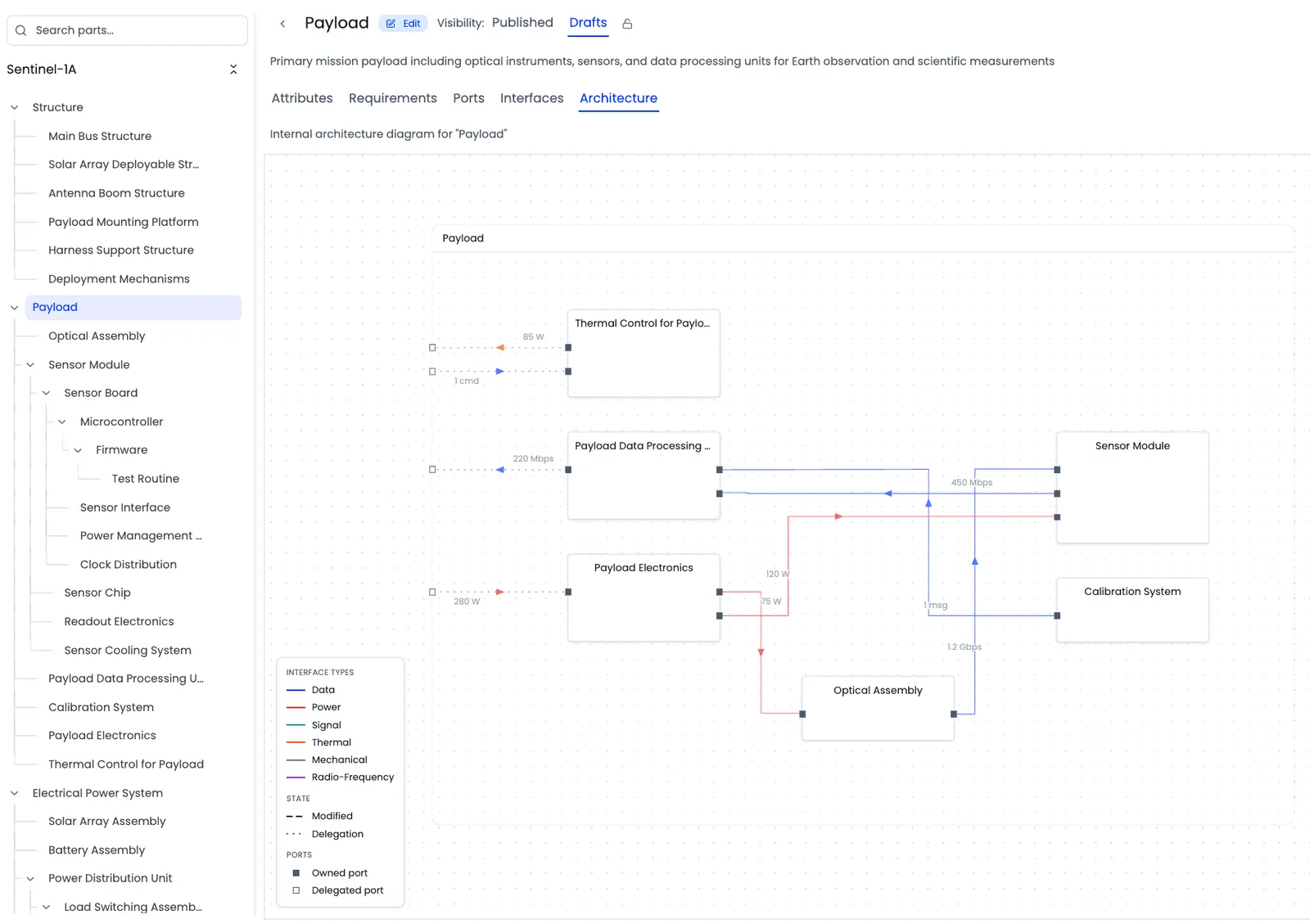
Where an engagement like this starts.
Systellar’s began with a free consultation and a paid exploration, and grew into an embedded team. Most engagements start with the technical audit: €4,900, fixed scope, report in 7 business days, senior judgment on what you’ve built and what to do next. The report stands alone, with no obligation to build with us afterwards.
If you already know you want the embedded shape, the partnership page describes how we work. And if you’re ready for neither, start the way Alexandre did: ask us a question. The first answer has always been free.
Questions founders ask us.
Who owns the code?
Systellar does, from day one: the repository, the infrastructure, everything in it. The same applies to every engagement we take.
What happens when Systellar outgrows the engagement?
That's the plan. They just hired their first in-house senior engineer/architect, with our help screening and interviewing candidates. The codebase was built for exactly this handover.
What does an engagement like this cost?
The technical audit is €4,900, fixed scope. The embedded partnership is a monthly retainer, scoped on a free call. If you're at accelerator stage, start with the audit.
Do you use AI to write the code?
Yes, inside a strict harness: typed end to end, machine-enforced conventions, guardrail hooks, and a person reviewing every change. The AI section further up the page shows how that works in this codebase.
Different domain.
Same partnership shape.
The engagement pattern translates. The domain doesn’t need to.
Tell us about
your domain.
Tell us what you’re building and what you know about your field that nobody else does. We read every message and usually reply within a day.
- hello@feathered.eu
- Phone
- +48 664 741 894
- Calendar
- Book a 30-minute call ↗